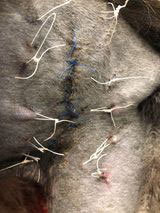
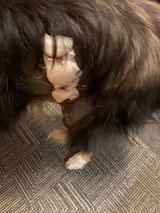
Bandaging a Dog
Sometimes a veterinary surgeon will ask an owner to confine their dog and monitor a bandage at home. Follow your vet's instructions and contact the practice promptly if you have any concerns.
Layers of a veterinary bandage
A veterinary bandage will often contain primary, secondary and tertiary layers:
- Primary layer: The sterile layer placed directly against the wound. Its purpose depends on the type and stage of the wound.
- Secondary layer: Provides padding, absorbs fluid and helps protect the injured area.
- Tertiary layer: Holds the other layers in place and protects them from dirt and damage.
A closed surgical incision may require a non-adherent dressing. An open wound may need a specialist dressing selected to support debridement or healthy granulation tissue. Modern dressings that maintain an appropriate moist wound environment have largely replaced traditional wet-to-dry bandaging.
Reasons a paw or leg may need protection
Your vet may advise bandaging or temporarily protecting a paw or leg following:
- A torn or damaged toenail
- A burnt or scraped paw pad
- A puncture wound
- A bite from another animal
- A bee sting or insect bite
- A paw-pad injury involving a loose flap
- A paw or nail infection
- Surgery
- A need to prevent licking or chewing
How a veterinary bandage is applied
Keeping a bandage dry
A veterinary bandage must remain clean and dry. Your vet may provide a waterproof cover, such as a clean drip bag, for very short periods when the dog goes outside.
A waterproof dog boot may also be useful outdoors if your vet agrees. Any waterproof covering must be removed as soon as the dog returns indoors because moisture and condensation can quickly build up inside it.
A clean sock may sometimes help keep a dressing in place indoors, but it should only be used with veterinary approval. It must not be tight or secured in a way that restricts circulation.

A sock used as a temporary protective covering over a veterinary dressing.
Monitoring a bandage at home
Check the bandage as often as your vet recommends. Contact the veterinary practice if you notice:
- Swollen, cold, hot or discoloured toes
- The toes spreading apart or disappearing into the bandage
- A bandage which has slipped, twisted or become tight
- Wetness, discharge, blood or an unpleasant smell
- Chewing or persistent licking of the bandage
- Increasing pain, restlessness or reluctance to use the limb
- Damage to the bandage or exposed padding
Do not remove or replace a veterinary bandage unless your vet has instructed you to do so. Never apply an elastic or cohesive layer tightly around a limb.
Bandaging the body
Bandaging areas such as the trunk, flank, hip, armpit or chest can be difficult because ordinary dressings tend to move. A close-fitting veterinary surgical suit may sometimes help protect a suitable wound, provided your vet agrees.
Tie-over bandages are another option for certain large or deep wounds. The usual dressing layers are held in place using tape or material passed through loops which have been sutured around the wound.
The sutures used for a tie-over bandage must be placed by a veterinary surgeon. Owners should not attempt to construct or replace this type of bandage themselves.
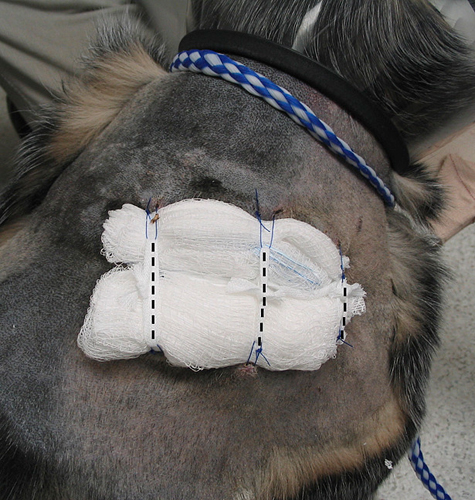
An example of a veterinary tie-over bandage.
The wound shown below was caused by a grabbing bite from another dog. After three surgical procedures and further tissue loss caused by necrosis, the veterinary surgeon applied a tie-over bandage.
The dressing was changed by the veterinary team every 48 hours and medical-grade Manuka honey was used as part of the prescribed wound treatment.